
Best Place to See Orangutans in Borneo: Sepilok with Kids
Thompsons vs the World contains affiliate links and is a member of the Amazon Services LLC Affiliates Program. Making a booking via these links will mean that we receive a small fee but this is at absolutely no cost to you. The price you pay will always remain the same. For more information please see our Privacy Policy.
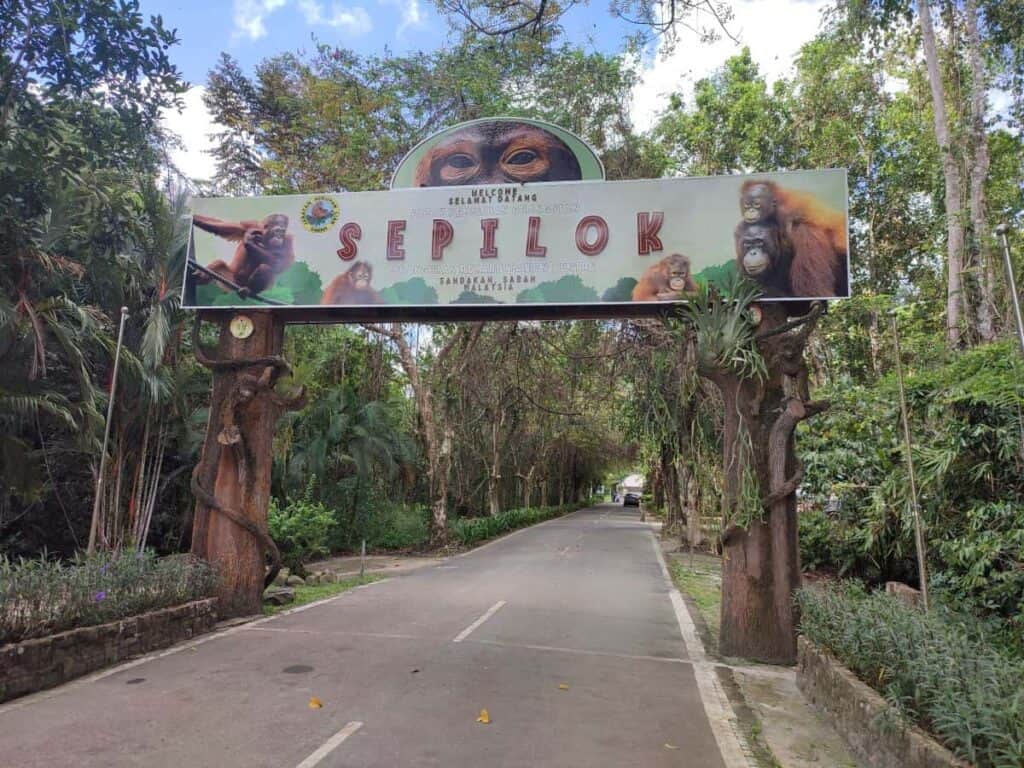
If seeing orangutans in Borneo with kids is high on your family travel bucket list, there’s one place that stands out above the rest: the Sepilok Orangutan Rehabilitation Centre. Founded in 1964, this world-famous sanctuary is widely regarded as the best place to see orangutans in Borneo, offering unforgettable up-close encounters in a natural rainforest setting.
When we visited Borneo with our boys, it was all about the wildlife for us. And watching these incredible apes swing through the trees and interact with one another was completely magical for all of us. Whilst we were also lucky enough to see orangutans in the wild during our Borneo adventure, getting to learn more about them in Sepilok – and see them up-close – was a real highlight too.
Here’s everything you need to plan your visit, what to expect, and how to make the most of this wonderful day on your Borneo adventure with kids.
Table of Contents
- Why Sepilok Is the Best Place to See Orangutans in Borneo
- Why Sepilok Is the Ethical Way to See Orangutans in Borneo
- How Visiting Works (Feeding Platforms, Nursery & What to Expect)
- 🦧 Want to visit Sepilok without worrying about logistics?
- Practical Tips for Visiting with Kids
- How Much Time Do You Need?
- Where to Stay in Sepilok
- Is Sepilok Worth It With Kids?
- Practical Info at a Glance
- Final Thoughts
- Planning a Bigger Borneo Adventure with Kids?
- Looking for more Borneo family holiday inspiration?
- FAQs: Visiting Sepilok with kids
Why Sepilok Is the Best Place to See Orangutans in Borneo
The Sepilok Orangutan Rehabilitation Centre is much more than a tourist attraction. It’s a working rehabilitation programme dedicated to rescuing, rehabilitating, and eventually releasing orphaned and injured orangutans back into the wild – all within the lush Kabili-Sepilok Forest Reserve.
Unlike zoos or animal displays, these orangutans live in a semi-wild environment where they’re gradually encouraged to forage, learn jungle survival skills, and develop independence. Visitors are restricted to walkways and observation decks to ensure minimal disturbance, meaning your family will see them behaving naturally – not behind fences or performing for cameras.
If you’re travelling Borneo with kids, this is one of those experiences that really stays with you — both because of how close you get to these incredible animals, and how much you can learn about them too in just one day out.
Why Sepilok Is the Ethical Way to See Orangutans in Borneo
One of the biggest questions parents ask when planning wildlife experiences in Borneo with kids (or anywhere in the world really) is whether it’s ethical – and rightly so. Whilst we really want our boys to be able to experience nature and see wildlife, we also want to teach them how to do this in the right way.
The reason we felt comfortable visiting the Sepilok Orangutan Rehabilitation Centre (and then recommending it to other families) is because this isn’t an attraction that’s just designed for tourists. It’s a working rehabilitation centre with conservation at its core.
Here’s why Sepilok stands out as the ethical option:
🦧 Orangutans live in a semi-wild environment
The orangutans at Sepilok aren’t caged or trained to perform. They live freely in the protected rainforest and are encouraged to forage, climb, and behave as naturally as possible. Feeding platforms exist to support rehabilitation – not to guarantee sightings.
The forest reserve here is huge, and the whole concept is that as the orangutans increase in independence they are gradually able to move deeper and deeper in to the forest and rely on the feedings less and less.
🌿 Conservation comes before convenience
There are no promises that orangutans will appear. If they don’t come to the feeding platforms, that’s considered a success – it means they’re finding enough food in the forest themselves. This is an important lesson for kids about respecting nature on its own terms.
👀 Viewing is carefully controlled
Visitors stay on raised walkways and designated viewing areas to minimise human impact. There’s no touching, no posing for photos with the orangutans, and no interactions that put orangutans under stress.
Whilst the viewing platforms CAN get crowded, these are set back from the orangutans to make sure the viewing tourists aren’t affecting them in any way.
📚 It’s genuinely educational
For families, this is huge. Sepilok opens up conversations about:
- Habitat loss and deforestation
- The illegal pet trade
- Why rehabilitation and rewilding matter
Our kids came away with a much deeper understanding of why orangutans need protecting – not just excitement from seeing them (though there was a LOT of that too!).
If you’re looking for the best place to see orangutans in Borneo while also modelling responsible travel for your children, Sepilok strikes that balance beautifully.
How Visiting Works (Feeding Platforms, Nursery & What to Expect)
🦧 Daily Feeding Times
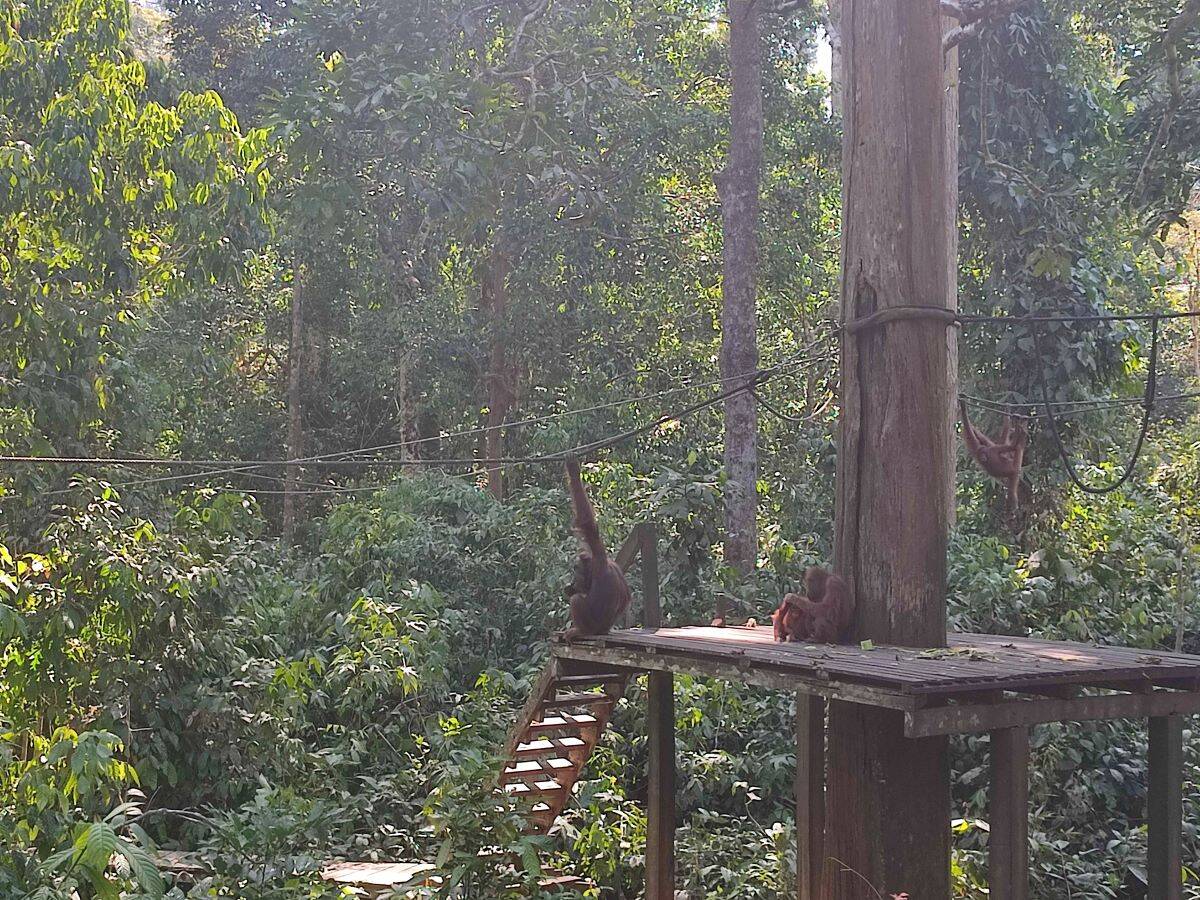
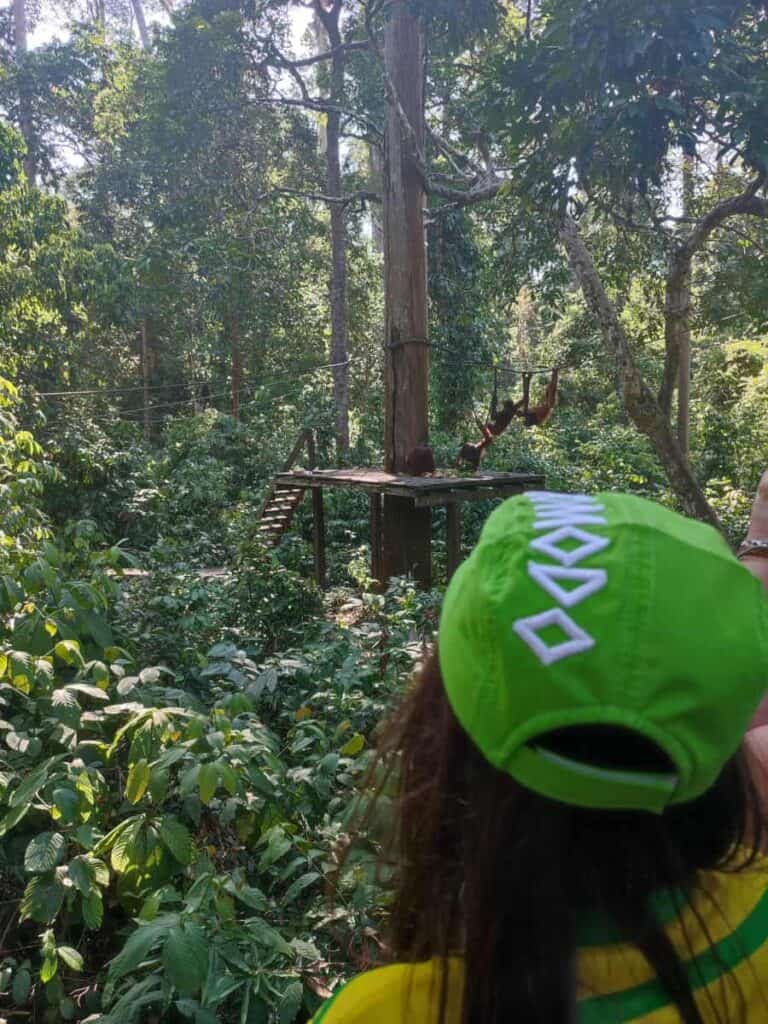
The highlight of any visit is seeing the orangutans during the feeding sessions. There are two scheduled feedings every day – once at 10:00am and again at 3:00pm – when trained rangers lay out fruit and vegetables and the orangutans swing down for a snack. As do the other local packs of monkeys, so you’re likely to get to see these too.
We found that the morning feeding tends to draw larger tour groups, so if you prefer a quieter experience (especially with kids), then the afternoon session can be a great alternative. And because your ticket is usually valid for the full day (and you can exit and return later), you can even do both if you like.
Which is exactly what we did – if you’re in Borneo, then why would you NOT want to maximise your orangutan time?
🐒 Outdoor Nursery & Viewing
Before or after the feeding platforms, make sure to explore the outdoor nursery area. This is where younger orangutans – often aged between about 3 and 9 years old – practise their climbing, swinging, and social skills. It’s an adorable and educational part of the experience, and our boys particularly loved watching the playful youngsters buzzing around on the ropes and platforms.
These orangutans also have access to the forest beyond so they can explore and gain their independence as they start to feel more confident.
There was an ENORMOUS alpha male in the nursery section during our visit which the boys were absolutely fascinated by as he was just so huge!
You watch the orangutans in the nursery space from an indoor seating area through one-way glass -which is great if you need a cool, shaded break as it’s gloriously air-conditioned. Plus there are info displays about the individual orangutans and the centre’s rehabilitation programme which puts what you see in to a bit more context.
There is also an indoor nursery at the centre but as this houses the youngest and most vulnerable orangutans this is understandably off-limits to visitors.
🐾 What You Actually See
As with any wildlife experience, there are no guarantees – orangutans might be foraging in the deeper jungle and skip the feeding platform altogether, especially during fruiting season when food is plentiful for them.
But even when that happens, there’s still plenty to enjoy – the outdoor nursery, walkways through the forest, and the sense of being immersed in the rainforest make it worthwhile. And in our case, we were lucky enough to see several orangutans at both sessions that day, including a mother and baby, which was genuinely unforgettable.

🦧 Want to visit Sepilok without worrying about logistics?
Booking a guided tour can be a great option for families – especially if you’re short on time or visiting from Sandakan. Tours usually include transport, timed entry around feeding sessions, and knowledgeable guides who help kids understand what they’re seeing.
👉 Check out this highly-rated family-friendly Sepilok tour here
Practical Tips for Visiting with Kids
From our own experience and what other families report:
📅 Plan Your Arrival
The centre opens around 9:00am and again in the afternoon. Arriving 30 minutes before feeding times gives you time to explore the walkways and secure a good viewing spot before the crowd arrives.
💵 Bring Cash
Tickets are cash-only on site, and often local currency is required for entry and lockers. Make sure you have enough before you arrive. We met several people who didn’t have cash with them and were caught out on arrival. Make sure this isn’t you!
🧃 Pack Light & Bring Water
The jungle can be hot and humid, and bags aren’t permitted in viewing areas. You can carry a water bottle with you but anything else will need to be safely stored in the lockers by the entrance (for a small additional fee).
👀 Expectations Matter
Seeing orangutans in a setting that respects their natural behaviour is part of the experience. They might not always come close, but when they do, it’s truly special – and a great opportunity to talk with kids about wildlife, conservation, and habitat protection.
How Much Time Do You Need?
We would recommend budgeting half a day here – or even the whole day if you want to catch both feedings and explore at a relaxed pace. The walkways and forest trails are gentle enough for kids and there’s enough to see around the nursery and feeding areas to keep interest high.
Pairing your visit with nearby attractions (like the Bornean Sun Bear Conservation Centre across the road) makes for a full and memorable day exploring wildlife in Borneo with kids. You can head to the morning feeding at 10am, check out the nursery for a while, then head to the Bornean Sun Bear Conservation Centre for a few hours before returning in time for the afternoon feed.
Where to Stay in Sepilok
For families visiting the Sepilok Orangutan Rehabilitation Centre, staying nearby makes life easier – especially if you want to take in both feeding sessions or handle early starts without tiring little legs. Being able to pop back to your hotel during the day means you get a bit of a break from the intense heat too, which we found really helpful for the kids.
We found that where we stayed in Borneo (especially with the intense heat) made a big difference to how easy it was to explore everything with the kids.
Here are some great options we recommend:
🌿 Budget Option: Sepilok B&B
Compared to the rest of Malaysia, Sepilok doesn’t have a wealth of real budget-friendly options. But this is a bit of a gem.
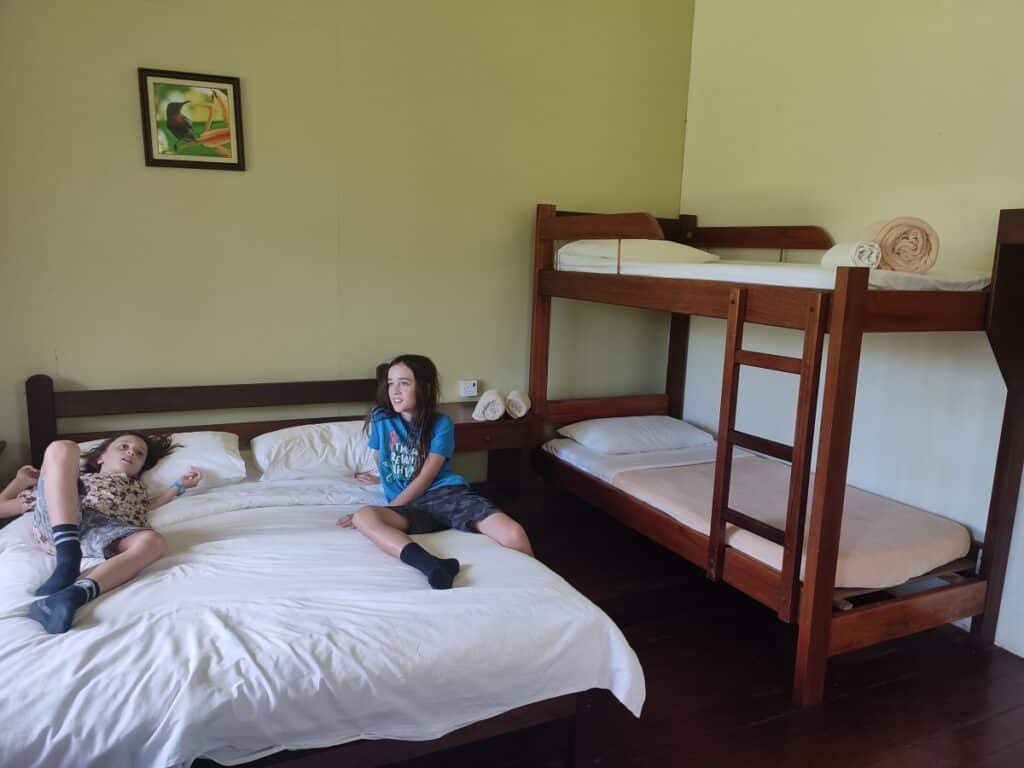
We stayed here during our visit, and it’s a brilliant family-friendly base. Rooms are spacious, there’s air-conditioning (which feels essential after a hot morning in the jungle), and breakfast is included. It’s also within walking distance of the centre and other attractions – perfect if you don’t want to depend on taxis in the heat.
🏨 Check rates for Sepilok B&B here – one of the few budget options for families in Sepilok
🦜 Jungle Lodge Option: Sepilok Forest Edge Resort
There are a few jungle lodges and small resorts within 1–2km of the rehabilitation centre. The most highly rated one for families is Sepilok Forest Edge Resort – we met several families who stayed here and raved about the gorgeous chalet rooms. Plus we were very jealous of the lovely pool for cooling off in!
🏨 You can check availability here for Sepilok Forest Edge Resort – family rooms book up fast so don’t wait too long to book!
🚗 Sandakan Base
If you want more dining options and flexibility, staying in Sandakan (about 25–30 minutes away by car) gives you access to restaurants, tours, and easy transport arrangements. This makes sense if Sepilok itself feels too quiet for your family’s taste (it is pretty small) or if you’re on a super tight timeframe. You’re likely to fly in and out of Sandakan Airport so you can do all of your day trips from Sandakan if you’re short on time.
Whichever base you choose, Sepilok works well as a wildlife hub – easy to reach from Sandakan, and perfectly placed for other kid-friendly adventures like the Kinabatangan River or rainforest night walks if your itinerary includes more time in Borneo with kids.
Being within walking distance (or a short drive) means less rushing, cooler starts to the day, and flexibility around feeding times.
Is Sepilok Worth It With Kids?
Absolutely.
If you’re looking for the best place to see orangutans in Borneo, Sepilok delivers in a way that’s both ethical and family-friendly. There are few wildlife experiences that offer such consistent chances to observe these incredible apes – and doing it in a setting that works with conservation and rehabilitation makes it extra educational for the kids too.
Seeing orangutans swing through the jungle and hearing their expressive calls is the kind of moment your family will remember for years – and it’s accessible even with younger children in tow.
And if it’s wildlife you’ve come to Borneo for, then Sepilok is the best jumping off point for so many more nature adventures. Many families combine a stay in Sepilok with a river safari along the Kinabatangan, where you can spot even more wildlife in the jungle.
And if you’ve got more time in Borneo, then taking a detour to Bako National Park in Sarawak will let you pack in yet another world-class wildlife watching experience.
Practical Info at a Glance
Feeding Times: 10:00 and 15:00 (daily)
Open Hours: 09:00-16:00
Tickets: Around RM30/£5.50/US$7.50 (adult non-Malaysian), RM15/£2.50/US$3.50 (child non-Malaysian)
Location: In the Kabili-Sepilok Forest Reserve, ~25–30 min from Sandakan
There is also an RM10/£2/US$2.75 fee to take a camera in to the feeding platform.
If seeing orangutans in the wild is a priority for your trip, Sepilok is one of the most accessible and ethical wildlife experiences in Borneo with kids.
👉 Browse tour options here to start planning your own orangutan adventure in Borneo
Final Thoughts
Whether you’re planning a short stop in Sepilok or building a wider Borneo with kids wildlife itinerary, the Sepilok Orangutan Rehabilitation Centre deserves top billing as the best place to see orangutans in Borneo.
It’s educational, deeply rewarding, and surprisingly easy to do with children — and every visit contributes to the ongoing work of protecting these amazing animals.
If you’re planning your trip, don’t miss our guide to the best places to stay in Borneo to help you choose the right base.
Planning a Bigger Borneo Adventure with Kids?
If visiting the Sepilok Orangutan Rehabilitation Centre is just one part of your trip, we’ve put together a free 2-week Borneo itinerary for families to help you join the dots.
It shows you:
- How to fit Sepilok into a realistic family route
- Where to go next for wildlife, rainforest, river adventures and chilled out beach time in a world-class resort
- How long to stay in each place without exhausting kids
- Practical tips for travelling Borneo with kids, based on our own experience
👉 Download our free 2-week Borneo itinerary for families here
Looking for more Borneo family holiday inspiration?
Check out our reviews and advice in our other posts below, or check out the full list of all our adventures across Malaysia here.
- Shangri-La Rasa Ria Review: Is this the best family hotel in Borneo?
- Visiting the Kinabatangan River with Kids
- Exploring the Rainforest Discovery Centre with kids
- Kuching Itinerary
- Visiting Bako National Park
FAQs: Visiting Sepilok with kids
Yes — for most families, Sepilok is considered the best place to see orangutans in Borneo. The rehabilitation centre offers one of the most reliable opportunities to observe orangutans in a natural rainforest setting while supporting ethical conservation work.
Absolutely. Sepilok is very family-friendly, with raised boardwalks, clear viewing platforms, shaded areas, and short walking distances. It’s an ideal wildlife experience for families travelling Borneo with kids, including younger children.
Whilst there are no complete guarantees, you are highly likely to see orangutans either in the nursery or at the feeding platforms (or both). Orangutans are free to roam the forest and may not attend feeding sessions, particularly during fruiting season. However, Sepilok still offers one of the highest chances of seeing orangutans responsibly in Borneo.
Most families should allow 1-3 hours, or longer if you want to attend both feeding sessions. Many visitors combine Sepilok with nearby attractions, making it an easy half-day or full-day outing.
It can be — if done responsibly. Sepilok is widely regarded as an ethical option because it prioritises rehabilitation and release, limits human interaction, and allows orangutans to behave naturally. This makes it a good choice for families wanting to model responsible wildlife tourism.
No — you can visit independently. However, booking a tour can be helpful for families who want transport arranged, help timing feeding sessions, or a guide to explain the rehabilitation process in a kid-friendly way.
Staying in or near Sepilok village is ideal for families, especially if you want flexibility around feeding times. There are also good options in Sandakan if you prefer more restaurants and amenities.


