
How to Travel More with Unpaid Parental Leave
Thompsons vs the World contains affiliate links and is a member of the Amazon Services LLC Affiliates Program. Making a booking via these links will mean that we receive a small fee but this is at absolutely no cost to you. The price you pay will always remain the same. For more information please see our Privacy Policy.
What if you could have a proper family adventure without quitting your jobs, taking the children out of school for a year or waiting until retirement?
When our children were 7 and 9, we took a family gap year. It was an incredible experience, but taking a whole year away from everyday life isn’t something every family can – or wants to – do more than once. Our boys are a tiny bit older now, they have set friendship groups and hobbies and whilst they definitely want to see more of the world still they also don’t want to be away from home for a whole year again.
Fast forward to 2026, and we found another way to make extended family travel happen. With our children now 10 and 12, we spent four months travelling through Central and South America, using a combination of unpaid parental leave and paid annual leave.
It got me thinking about how much potential there is in unpaid parental leave for family travel. It might not give everyone the opportunity to take a year off, but it can help create something in between: a few extra weeks away, a longer summer adventure or even a much bigger trip when combined with annual leave.
If you have school-aged children and a job you want to return to, this could be a way to make more family travel possible without completely changing your life. We’ll delve into exactly what unpaid parental leave is, who is eligible and how this little known leave entitlement can really change your thinking when it comes to family travel adventures.
You don’t have to take a family gap year to travel more
I loved our first family gap year. Travelling with children aged 7 and 9 gave us time to experience places at a different pace, and it showed us just how rewarding longer-term travel could be. A whole year gave us real, focused time out of ‘normal’ life, work and school and it was a real privilege to be able to step back for a while and spend that time with the kids.
But a family gap year is a big undertaking. It isn’t financially or practically possible for everyone, and you might not want to put your career on hold for that long. If your kids are in mainstream school then you also might not want to disrupt this for a whole year.
Our more recent four-month trip to Central and South America was a different proposition. We weren’t starting from scratch or stepping away from work indefinitely. We were working with the leave available to us and combining different types of time off to make a substantial adventure possible.
We already know that once our eldest starts studying towards his GCSEs here in the UK we won’t feel comfortable deregistering him from school again. So for family adventures as the kids get older our long-term plan is to use unpaid parental leave to allow us to take the full six week Summer holidays, which will be plenty of time for exploring somewhere exciting.
And that’s the point I want to make: family travel doesn’t have to be all or nothing.
You don’t need twelve months to have an experience that feels different from an ordinary holiday. An extra week or two can change the shape of a trip. It can mean travelling further, spending longer in one place or having enough time to build a journey around experiences rather than rushing between destinations.
For some families, that might mean a three-week summer trip within the school holidays instead of two weeks. Or you could take the entire 6-weeks school holidays and really explore a region somewhere. For others, it could mean adding a few days to Easter or Christmas. And if you have enough leave available, combining unpaid parental leave with annual leave could make a much longer adventure possible.

What is unpaid parental leave in the UK?
Unpaid parental leave is a statutory entitlement for eligible employees in the UK. It is separate from your annual holiday allowance and is designed to give parents time away from work to look after their children.
According to GOV.UK’s guidance on unpaid parental leave:
- You are entitled to up to 18 weeks total of unpaid parental leave for each child.
- The entitlement applies to each child up to their 18th birthday.
- The usual limit is four weeks per child in each year, unless your employer agrees otherwise.
- Leave is normally taken in whole weeks, rather than individual days, unless your employer agrees otherwise or your child is disabled.
- You do not have to take all your entitlement at once.
There are eligibility requirements, and there are rules about requesting and taking the leave. So don’t assume that having children automatically means you can take it whenever you like. Read the full GOV.UK parental leave guidance and check your circumstances with your employer or HR department before making plans.
The important thing for family travel is that parental leave is additional time away from work, rather than simply another name for your annual holiday.
It is unpaid, of course. That means you need to think carefully about the financial side. But if you can make the numbers work, it could give you more flexibility than relying on your annual leave alone.
Combining unpaid parental leave with annual leave
This is where things get interesting for families who want to travel for longer.
Annual leave is often the first thing we think about when planning a family holiday. But if you use some unpaid parental leave alongside it, you may be able to extend the time you have available. This then really opens the world up to you; those dream places that felt way too difficult in a standard 2-3 week Summer holiday now become more realistic.
That was the approach we used for our four-month trip through Central and South America in 2026. We combined unpaid parental leave with paid annual leave to make the longer trip possible. We knew we wanted another longer travel adventure and as soon as we came back from our family gap year we started saving again and crunching the numbers to figure out what might work.
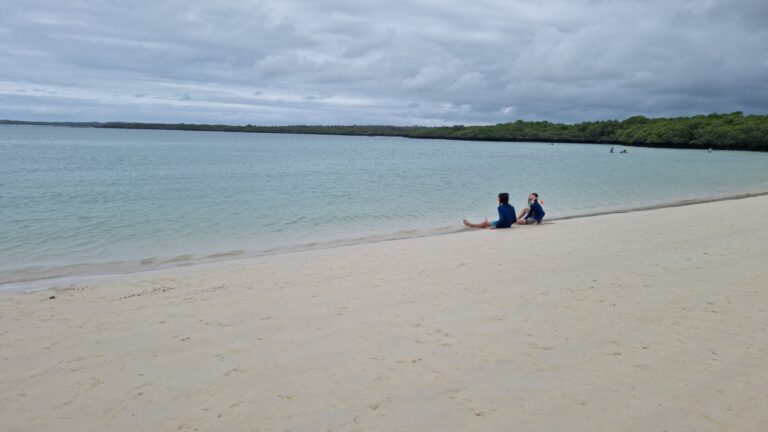
One of our absolute dream family travel destinations was Galapagos – but we knew this was the kind of place we ideally needed more time for. So we worked backwards from the Galapagos Islands and planned the rest of our itinerary around that. We knew we wanted to incorporate more worldschooling so we found an amazing worldschooling hub in Guatemala where the boys enrolled for a month. We travelled up to Mexico so my 10-year-old could do his PADI Open Water certificate on the reefs off Cozumel. Then we spent several weeks exploring mainland Ecuador before hopping on our flights out to the Galapagos Islands.
Four months really felt like the sweet spot for us this time – plenty of time for an epic adventure, the chance to explore more far-flung destinations but not so long away that we needed to ditch everything back home.
It was a very different arrangement from taking a full family gap year when the children were younger. Rather than treating time away from work as one enormous block, we were able to use a combination of leave to create the time we needed.
As we have two kids this meant we were entitled to 8 weeks of unpaid parental leave each. We both have 6 weeks of paid annual leave per year too; the remaining 2 weeks we negotiated as additional standard unpaid leave to take us up to 16weeks in total.
And you don’t necessarily need to be planning four months away to benefit from this approach. Even a relatively small amount of unpaid leave – just an extra week – can make a difference.
For example, you might use annual leave for the main part of a summer holiday and add a week of unpaid parental leave to extend it. Or you could use a few days of annual leave around a school holiday and take an additional week of parental leave, subject to the rules and arrangements that apply to you.
The best arrangement will depend on how much annual leave you have, how much parental leave you can take, your employer’s policies and what you can feasibly afford.
The useful question isn’t just how much holiday you have. It’s how much time you could create by combining the leave available to you.

Why longer family trips can be worth the unpaid time
Taking unpaid leave means accepting a drop in income. That’s a massive, real consideration, especially when you’re paying for travel for a whole family. You’ll need to plan your income across the year to make it stretch and cover those months when the unpaid leave takes effect.
But I do think it’s worth looking at the trade-off in a slightly different way.
When we took our first family gap year, our children were 7 and 9. In 2026, they were 10 and 12, and we were able to spend four months exploring Central and South America together.
Those are two very different stages of childhood, and two very different travel experiences. I’m glad we didn’t assume that the only way to have meaningful extended family travel was to take another entire year out. Saving for our family gap year took us several years and honestly, I just didn’t want to have to wait until the boys were in their late teenage years for our next big adventure.
You absolutely can still have an adventure that feels significant, even if you’re only away for a few extra weeks. But those extra weeks can make such a difference – more time for everyone to actually switch off and get into the swing of travel, more opportunity to get off the beaten track and explore somewhere new and exciting and just so much more time with the kids whilst they are still at an age where they really value family time.
Of course, unpaid leave won’t suit every family’s finances or work arrangements. You might decide that losing some income isn’t worthwhile, or that your employer can’t accommodate the dates you want. But it’s an option worth considering before assuming that your annual leave allowance is the limit of what you can do.
How to work out whether unpaid parental leave could work for your family
Before you start planning a route or getting excited about destinations, I’d work through the practicalities.
1. Check your parental leave entitlement
Start with the official GOV.UK parental leave guidance. Check the eligibility requirements and how much leave you may have available for each child. Remember that the usual annual limit is four weeks per child, unless your employer agrees otherwise.
2. Find out what your employer allows
Read your workplace policy and speak to HR if you’re unsure how the rules apply to you. You need to understand how to request the leave, what notice is required and whether your employer has any additional arrangements.
3. Look at your annual leave balance
Work out how much paid annual leave you can use alongside parental leave. If you’re travelling with another parent, you’ll also need to consider how their leave fits into the plan.
4. Calculate the financial difference
Work out how much income you would lose by taking unpaid leave. Include the effect on your regular household budget, not just the cost of flights and accommodation.
For us, the four-month trip in 2026 was made possible by combining different types of leave. But the right balance will look different for every family. You might find that one additional week is manageable, even if a much longer trip isn’t.
5. Plan the trip around the time you can realistically take
You don’t need to start with an ambitious four-month itinerary. Begin with the amount of time you can make available and think about what kind of adventure would fit.
An extra week might be enough to turn a conventional holiday into a slower journey. A few weeks could give you the chance to visit several places without rushing. The important thing is to make the time work for your family, rather than planning a trip first and hoping the leave will fall into place.
You can make more family travel happen without taking a year off
Our family gap year when the children were 7 and 9 was a brilliant experience. But our four months in Central and South America in 2026 reminded me that you don’t need to recreate that exact experience to have another meaningful adventure.
Using unpaid parental leave for family travel can be a really practical way to make more time together. Combined with annual leave, it could give you the opportunity to take a longer summer trip, explore somewhere further afield or simply spend more time travelling as a family.
It won’t be right for everyone. You’ll need to check your entitlement, talk to your employer and be comfortable with the financial implications of taking unpaid time off.
But if you’ve been looking at your annual leave allowance and thinking that it isn’t enough, don’t assume that’s the only option. The unpaid parental leave entitlement in the UK is largely unheard of and completely under-used, but it’s a brilliant way to travel more as a family.
A full family gap year might not fit your life right now. But that absolutely doesn’t mean you have to settle for the occasional two-week holiday either. There may be a middle ground – and it could be the perfect way to fit more adventure into family life.
Thinking about where your unpaid parental leave might be able to take you?
Check out our travel guides for more inspiration on all kinds of family travel destinations that might be made more possible with that extra time off.
- All our shorter travel itineraries are here
- If you have longer, check out our guide on planning a family gap year here
- Find out more about worldschooling
- Our guidance on packing for long term family travel is here
- Discover exactly what our family gap year actually cost
- How to deregister your kids from school for family travel